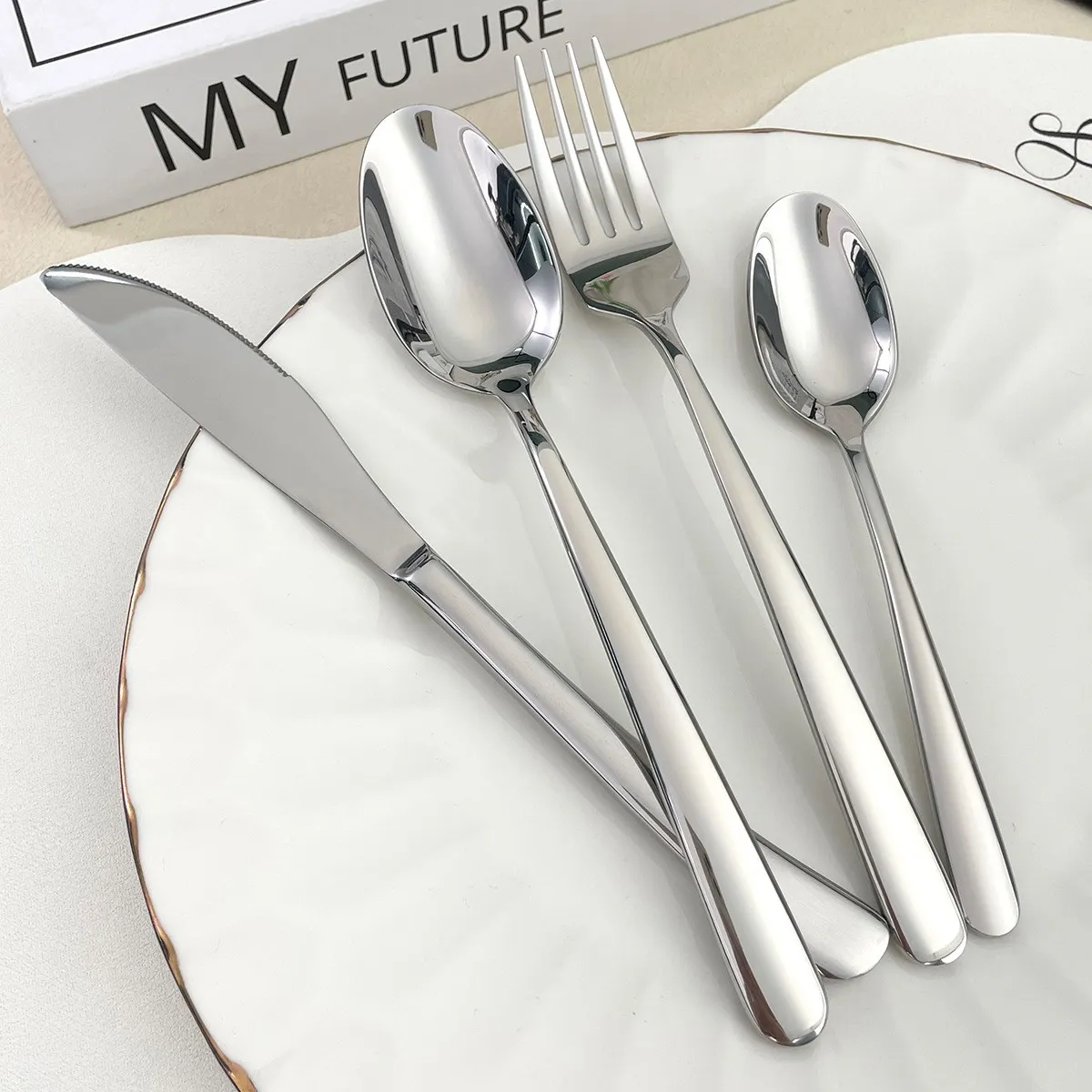
What Does 'food Grade Stainless Steel' Actually Mean?
May 22, 2026
Walk into any commercial kitchen or browse premium cutlery sets, and you'll see the label "food grade stainless steel" stamped on knives, forks, and spoons. But behind this familiar phrase lies a sophisticated metallurgical reality - one that separates safe, durable tableware from cheap imitations. For professional chefs, restaurant owners, and home cooks, understanding the true meaning of food-grade stainless steel is essential to avoid corrosion, metal leaching, and early utensil failure. This article deconstructs the science, grades, regulatory standards, and unique business innovations surrounding stainless steel cutlery (knives, forks, spoons). Plus, five critical FAQs that cut through marketing hype.
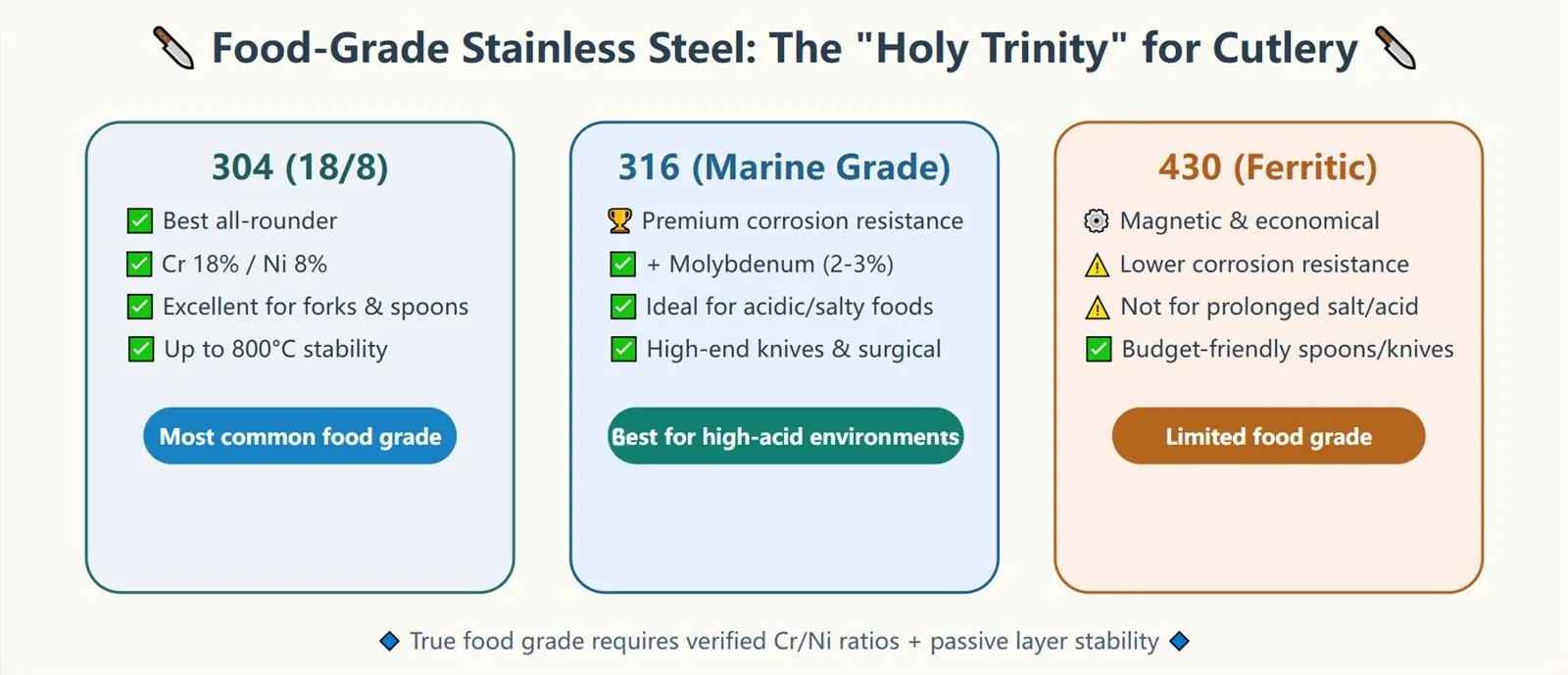
The three dominant stainless steel families used in food contact cutlery - 304 (universal), 316 (maximum durability for forks/spoons exposed to aggressive sauces), and 430 (economical but with limitations). Real food grade status depends on certification and corrosion testing..
Defining "Food Grade" - More Than a Marketing Stamp
In regulatory terms (FDA, EU 1935/2004, LFGB), food grade stainless steel refers to alloys that do not transfer harmful constituents into food under intended use conditions. But the reality for knives, forks, and spoons goes deeper: the steel must resist pitting, crevice corrosion, and maintain a passive chromium oxide layer that self-repairs. For cutlery, food grade implies three things: (1) the alloy composition (minimum 16% chromium, often 8-10% nickel), (2) surface finish (smooth, non-porous), and (3) manufacturing process that avoids heavy metal contamination. Surprisingly, many "stainless" spoons from low-cost imports fail these standards after 20 dishwasher cycles - they discolor, rust, or release nickel ions. Genuine food-grade cutlery uses 304 or 316 austenitic steel, certified via extraction tests (e.g., 0.5% citric acid at 70°C for 2 hours = no detectable migration).
Why Knives, Forks and Spoons Have Different Requirements
While all three are cutlery, each piece interacts uniquely with food and stress. Forks have tines that trap food residues - if steel is not fully food grade, crevice corrosion starts. Spoons experience repeated scraping against bowls and high-acid sauces (tomato, vinegar), demanding high pitting resistance equivalent (PREN > 19). Knives face mechanical abrasion and edge exposure; food-grade steel here also needs sufficient hardness (typically 440 series for blades). However, the industry's best practice for knives is to use 304 or 316 for the handle, and a martensitic blade (e.g., 420 or 440 modified) that still meets food-grade migration limits. The innovative business insight: hybrid cutlery sets with different grades per component are emerging as the premium standard, optimizing both safety and performance.
The Role of Surface Finish & Electrolytic Passivation
Food-grade stainless steel isn't only about composition - the surface must be free from iron contamination. Industrial passivation (nitric or citric acid bath) removes free iron and enhances the chromium-rich layer. For high-volume cutlery manufacturing, a superior passivation process can increase corrosion resistance by 300% compared to untreated steel. Many businesses overlook that once a knife or fork is stamped and polished, if the edges are burnt due to improper grinding, local chromium depletion occurs - creating non-food-grade zones. Leading brands now use laser-assisted passivation on spoon bowls and fork tines, drastically reducing nickel release. This is a unique selling point: "certified nano-passivated" cutlery commands 40% price premium in B2B hospitality markets.
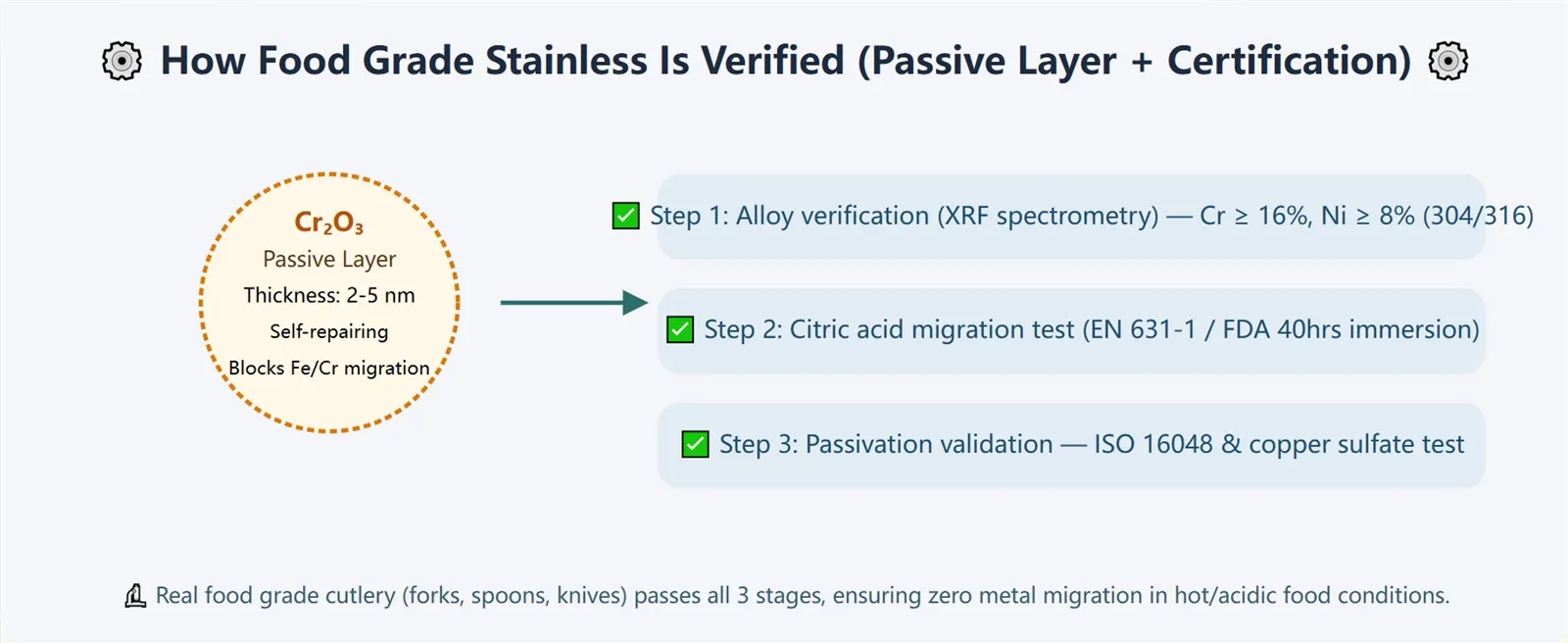
The certification pipeline for food-grade stainless steel cutlery - from passive chromium oxide layer verification to strict migration tests. Business advantage: certified cutlery reduces liability and brand risk.
Business Edge: Why Food Grade Differentiates Premium Tableware
For cutlery manufacturers, importers, and hospitality chains, the "food grade" label directly impacts profit margins and customer safety. Restaurants using non-certified stainless forks face unexpected pitting after 6 months, leading to guest complaints and replacement costs. In contrast, certified 316 stainless spoons last over 10 years in harsh dishwashers. An innovative procurement strategy is lifecycle cost analysis (LCCA): cheap 430 cutlery may cost 40% less upfront, but replacement frequency is 4x higher, and corroded utensils can leach iron into food, altering taste and violating health codes. The disruptive trend: blockchain-tracked food-grade certification for cutlery, where end-users scan QR to see mill certificates, passivation dates, and migration test results - this transparency is becoming a B2B sales advantage.
The Hidden Factor: Nickel Release & Allergies
A nuanced but critical aspect of "food grade" is nickel release. Austenitic stainless (304/316) contains 8-10% nickel, which provides formability and corrosion resistance. However, a small population has nickel sensitivity. Forks and spoons in contact with acidic foods (citrus, vinegar) can release trace nickel - below legal limits (0.1 mg/kg) - but some high-end manufacturers now produce nickel-free food grade alternatives like high-manganese or nitrogen-alloyed grades (e.g., 204Cu). These maintain food safety without nickel. Unique business insight: marketing "hypoallergenic food-grade stainless cutlery" opens a niche for allergy-conscious consumers and high-end health spas.
❓ Five Critical FAQs About Food Grade Stainless Steel (Knives, Forks, Spoons)
Q1: Does food grade stainless steel ever rust? If yes, is it still safe?
A: Even genuine food grade can develop surface rust if exposed to harsh chlorides or if the passive layer is damaged (e.g., scratching with carbon steel). However, light superficial rust can be removed and the utensil remains safe after repassivation. Extensive pitting may compromise safety - then replace. Rust spots on cutlery often indicate the steel is not true food grade (below 16% Cr) or incorrect cleaning.
Q2: Can I use ordinary "stainless steel" forks and spoons for cooking or serving?
A:Only if they're certified food grade. Non-food-grade stainless may contain too much lead, cadmium, or insufficient chromium - leading to toxic metal migration into hot/acidic foods. Always look for "18/8", "18/10" or "304" markings. Avoid unlabeled cutlery from discount retailers for serving hot meals.
Q3:Is 316 stainless steel overkill for spoons and knives at home?
A:For everyday home use, 304 offers excellent food-grade performance. However, 316 becomes valuable if you regularly cook with salt, vinegar, or live in coastal areas (salt air accelerates corrosion). For commercial kitchens handling pickled foods or high-chloride dishes, 316 forks/spoons are the smarter choice.
Q4:How can a restaurant owner verify if supplied cutlery is truly food grade?
A:Request mill test certificates (MTC) and EN 1186 migration reports. Also, conduct a simple 24-hour salt spray or vinegar immersion test: genuine food-grade will show no orange rust or black spots. Alternatively, use XRF analyzer for composition - Cr% above 16% and Ni% above 8% indicates 304 grade.
Q5: Can food grade stainless steel knives lose their food-safe status over time?
A:Yes, if the surface is severely abraded by improper sharpening or abrasive cleaners, the passive layer may be compromised. However, re-passivation with citric acid restores food-grade condition. That's why professional cutlery services periodically passivate knives - a novel maintenance service model gaining traction.
Future-Proofing: Circular Economy and Food Grade Innovations
The next frontier in food-grade cutlery involves antibacterial stainless - copper-infused surfaces (e.g., SS304 with 1-3% Cu) that kill pathogens while remaining fully food-grade. Additionally, "visible passivation indicators" are being developed: spoons that change color temporarily when the passive layer needs reactivation. For business operators, educating staff on proper handling - no chlorine-based bleach soaking, immediate drying - extends cutlery lifespan. Beyond regulation, "food grade" is a living standard that evolves with sustainability demands, making stainless forks, knives, and spoons the most environmentally sound high-temperature, high-contact food tool ever invented.
Conclusion: "Food grade stainless steel" is not a generic claim - it's a guarantee of alloy composition, surface integrity, and safety performance specifically designed for direct food contact. For knives, forks, and spoons, understanding the differences between 304, 316, and 430 helps buyers avoid rust, off-flavors, and health risks. In a market saturated with ambiguous labels, a deeper metallurgical insight empowers businesses and households to choose cutlery that lasts, performs, and protects.
AOFFEE is a China manufacturer of high‑quality stainless steel cutlery. Our 18/10 forged knives, forks, and spoons meet ISO9001, ISO 8442,NSF,BS OHSAS 18001 standards, feature satin finishes, and are designed to fit ergonomic preferences. We offer competitive pricing and bulk discounts for professionals. Request a sample or view our full collection.
Related products